

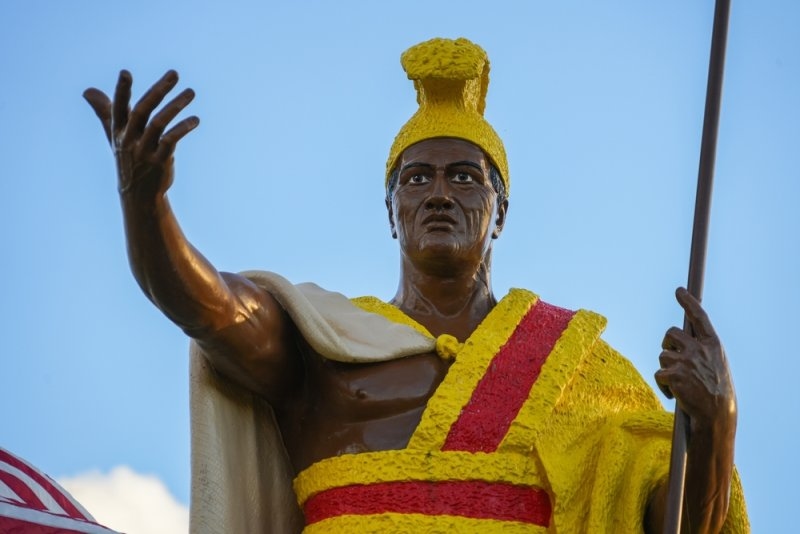
While Hawaii is known for its beautiful beaches, volcanoes, and culture of the islands, a fascinating aspect of Hawaii is its history as its own country. The islands were unified under a monarchy under a respected king prior to being included with the United States, and the story of the Hawaiian Kingdom is vital to explaining how the islands gained their modern culture and the importance of their royalty today.
The Hawaiian Kingdom was established in 1795 and remained in power until 1893. The Hawaiian monarchy was created when Kamehameha the Great conquered the main islands and unified them into one sovereign nation. Prior to this, separate island chiefs fought each other for control.
The establishment of a unified kingdom brought political stability to the islands, as well as began more solid relations with countries outside the kingdom, and it became a fully recognized nation in the world, which can be explained by studying its history today.
One of the greatest rulers and significant figures in Hawaiian history was King Kamehameha the Great. Born during a time of island dispute between powerful island chiefs, King Kamehameha rose to power with his determination and leadership. By forging alliances with powerful rulers on other islands, introducing and using weapons that were given from trade with other countries, and commanding strong military action, he took over most of the Hawaiian Islands and eventually created the Kingdom of Hawaii, with him in control of the islands from the successful battle over Oahu called the Nu' uanu Battle.
After forming his kingdom, Kamehameha spent much time ruling wisely in order to increase trade and protect the islands from being invaded by foreign countries. His reign alone lasted about a century in history books.
After the end of Kamehameha the Great's reign, his descendants continued ruling the Hawaiian Kingdom, but in very different conditions. During this time of ruling the Hawaiian Islands, visitors like tradesmen, missionaries, and explorers were visiting the islands more often, and brought new customs and technologies that influenced the Hawaiian Islands and the people residing there today.
This was also a time when new laws and rules were created in order for the monarchy to be a much more modernized form of government. Over the course of the time period, the monarchical government began to implement written laws, had a much stronger influence over politics, and began building much more respectable relations with countries throughout the world.
There were several monarchs in Hawaii who made significant accomplishments within the kingdom. Many of them played important parts in ruling the nation. King Kamehameha III helped to develop the constitution, making changes to the way it was run and strengthening relationships with the United States and other nations around the world. King Kamehameha IV focused more on helping with health and medicine. He, along with Queen Emma, worked to establish health care throughout the kingdom, which benefited many people.
The reign of King Kalakaua was known as the 'Merrie Monarch' because he was very keen on promoting Hawaiian arts and music, along with cultural traditions to support and hold on to the Hawaiian culture in the islands. His descendant, Queen Liliuokalani, was the last monarch and fought hard for the rights and power of native Hawaiian people, ruling when the Hawaiian Kingdom was coming to an end in the islands.
One remarkable part of Hawaiian History and of the Hawaiian Kingdom's reign is how the monarchy was able to establish foreign relationships throughout the world. In the 19th century, many of the greatest empires around the world were able to recognize Hawaii as a free and independent kingdom.
Delegations traveled abroad to the U.S., parts of Asia, and Europe to create relationships with these powers. The Hawaiian monarchy was able to maintain strong economic and political ties with the outside world, which enabled it to take part in international trade. The location of Hawaii in the Pacific Islands made it a valuable part of many trading routes; it is for this reason that the nation prospered as much as it did.
Understanding the Hawaii kingdom timeline helps many people understand the past and what occurred. By understanding the past of the islands, it is easy to find a connection to modern-day Hawaii.
The latter half of the 1800s sees increasing economic and political pressures from foreign businesses and interests, and Hawaii's monarchy is overthrown in 1893.
After overthrowing the monarchy, a provisional government was set up, followed by the Republic of Hawaii, and it was finally annexed by the United States in 1898, eventually becoming a state in 1959.
The heritage of the Hawaiian monarchy has played a vital role in forming the islands and their culture today. The historical landmarks of the Hawaiian rulers have survived to this day, as well as some traditions and festivals that continue to exist as we know them. People study the history of the monarchy to get a sense of Hawaii's cultural identity and struggle for power within the islands themselves, and also to show their admiration for those who helped build Hawaii and make it the paradise it is today.
Festivals still occur today where many of the island's traditions are demonstrated for people who have not had the opportunity to witness them before.
The Hawaiian Kingdom truly was much more than just a group of islands; it was an independently ruled nation that influenced the people and the way that the islands would later develop. From Kamehameha the Great to Queen Liliuokalani, the rulers of the kingdom had their struggles and triumphs, and their story is essential to understanding Hawaii today.
The history of the Hawaiian Kingdom's rule and the timeline of their rule help many understand the importance of their legacy within Hawaii today.
Yes, the Hawaiian Kingdom did have its own national flag. It contained various emblems that symbolized the kingdom's international dealings and naval prowess, and was flown over government buildings, ships, and at official government meetings or representatives abroad. Many modern reproductions of the old Hawaiian flag are still shown during cultural festivals and in educational environments.
Yes, women were able to assume significant positions of authority during the Hawaiian monarchy. The last and best-known monarch of Hawaii was Queen Liliuokalani, who was the last person to hold such a title in Hawaiian history. Members of the royal family often took on key roles and maintained positions of power and influence, also in their efforts to retain Hawaiian culture and history.
The Hawaiian language was initially used during the Hawaiian Kingdom, though eventually the language also became used on a larger scale as international dealings with the United States increased. Official writings, official letters, and publications, such as newspapers and books for education, were typically published in both languages.
Yes, the Hawaiian royal sites are still able to be visited by the general public. Many of the old Hawaiian royal residences, statues, and royal mausoleums still exist today as a way to illustrate the history of the Hawaiian Kingdom, as well as show visitors the lifestyle the monarchs led.
This content was created by AI